
When a Bitcoin Transfer Has a Deadline
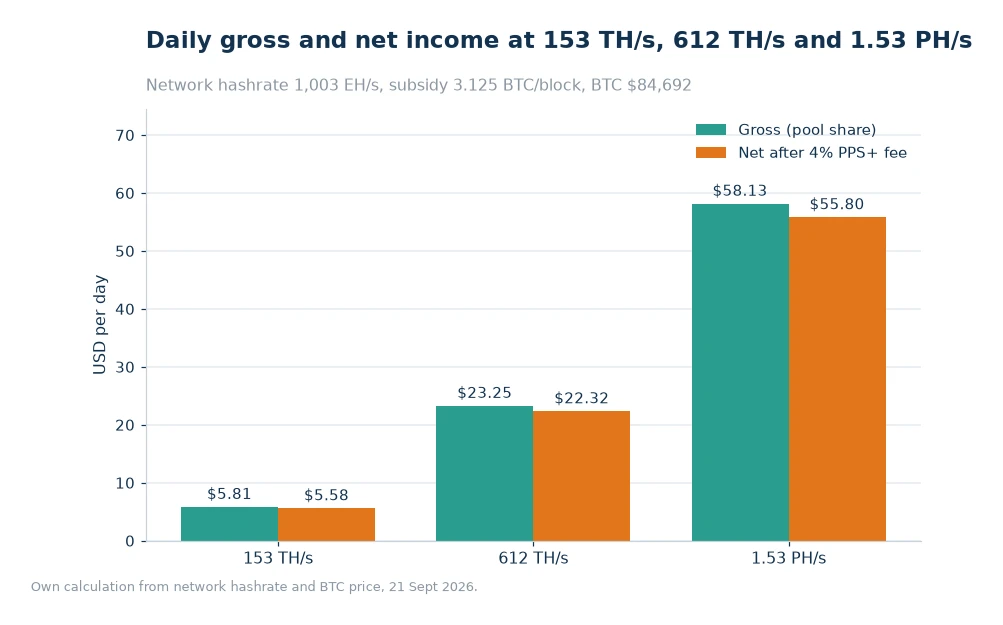
A payment with a date attached is a different problem from a payment that is merely slow. The accelerator's promise is inclusion in the next block the pool mines, not inclusion by a stated hour, so the honest question is whether the pool's block cadence fits inside your deadline. At 153 TH/s the account earns $5.81 a day gross; spending a day of that on a fee is a decision with a visible price, and it is worth making before the clock starts.
Key takeaways
- Free acceleration needs a transaction of 0.5 KB or less paying at least 0.0001 BTC/KB, plus room in the hourly quota.
- Inclusion happens in the next block the pool mines, which is a cadence rather than a timestamp.
- A submitted request cannot be cancelled and its fee is not refunded, so a deadline does not permit a rushed submission.
- At 153 TH/s a $4.23 fee equals about 0.73 of a day's gross income, which is the right scale for the decision.
The deadline reframes the whole calculation
Without a deadline, the cheapest option is almost always patience: the transaction confirms when fees fall or when a miner includes it, and nothing is spent. With a deadline, patience acquires a cost, and that cost has to be compared with the fee. The comparison is not "fee versus nothing" but "fee versus the consequence of being late", and only the person with the deadline knows the second number.
Write the consequence down before opening any tool. A missed supplier payment, a settlement that rolls to the next business day and a personal transfer that can wait are three different problems wearing the same interface. The tool behaves identically in all three cases, which is exactly why the judgement has to happen outside it.
What the accelerator actually commits to
The commitment is priority inside the next block that the pool mines. If the pool finds a block in twelve minutes, the transaction is in it; if the pool's next block is two hours away, the transaction waits with it. That is a real advantage over an ordinary queue, where inclusion depends on the fee relative to everyone else's, but it is not a scheduled service.
Read the wording carefully and the planning follows. Build a margin of at least one block interval, and preferably several, between the expected inclusion and the actual deadline. A request submitted an hour before a hard cutoff is a bet on block timing, and block timing is the one variable nobody controls.
Pricing the wait against daily income
For a miner, the natural yardstick is a day of production. At 153 TH/s the gross credit is 0.00006864 BTC, $5.81 at $84,692, or $5.58 after the listed 4% on the block-reward component. A half-kilobyte transaction at the free-route minimum carries $4.23 of fee, which is 0.73 of a day's gross. At 1.53 PH/s the same fee is 0.07 of a day.
That comparison does not decide anything by itself, but it prevents two common errors. The first is treating a $4 fee as trivial when the transfer is small. The second is treating it as outrageous when the transfer is large or the deadline is expensive. Scale is what makes a fee reasonable, and scale is local to the sender.
Always test the free route first
Free eligibility is a pair of conditions rather than a queue position: size at or below 0.5 KB and a fee rate of at least 0.0001 BTC/KB. A wallet that built the transaction from a single input usually satisfies both. A wallet that swept a dozen small outputs often does not, and the size is the reason.
The hourly quota is the second gate. Free requests are handled in the order received, and capacity resets each hour, so submitting early in a window is better than submitting late. If the window is full, the choice is to wait for the next one or to pay, and a deadline may make that choice for you. Either way, the check costs nothing.
The paid route and its currencies
Paid acceleration can be settled in BTC, BCH or LTC, with the charge taken from the account balance. Accepting three currencies is a small convenience with a real effect: a wallet holding only the stuck coins can still pay for help from somewhere else. Keep a modest balance available if deadlines are a recurring feature of your month.
Before relying on the tool, know its name and its page: the ViaBTC TX Accelerator states the conditions, the currencies and the refund rule in one place. Two rules deserve repeating before any payment. A request cannot be cancelled once accepted, and the fee is not refunded. A double-spend is refused outright, and a transaction with unconfirmed inputs has to wait for its parent. None of these are negotiable at the support desk, so the moment before submission is the only moment when a mistake is cheap to fix.
Four routes against one deadline
The table compares the options by what they cost, when they can land and whether the decision can be taken back. Block intervals are described as cadence rather than minutes because the pool does not publish a schedule.
| Option | Fee | Landing time | Reversible |
|---|---|---|---|
| Free acceleration | $4.23 at the minimum rate | Next pool block, if quota allows | No |
| Paid acceleration | Set at submission, paid in BTC, BCH or LTC | Next pool block after acceptance | No, no refund |
| Wait for the network | Nothing extra | Unknown; depends on fee level | Yes, by waiting |
| Rebuild with a higher fee | New transaction, new fee | After the new broadcast | Only if unconfirmed |
Worked example
Put a number on the fee and on the daily income it competes with.
- Set the base rate first: 450 ÷ 1,003,000,000 = 0.00000044865 BTC per TH/s per day.
- 153 TH/s: 153 × 0.00000044865 = 0.0000686435 BTC a day.
- Gross dollars: 0.0000686435 × 84,692 = $5.8125, rounded to $5.81.
- After the listed 4%: 5.8125 × 0.96 = $5.58.
- Minimum free-route fee on 0.5 KB: 0.00005 BTC = $4.2346.
- Fee as a share of gross income at 153 TH/s: 4.2346 ÷ 5.8125 = 0.73 of a day.
- At 612 TH/s: $23.25 gross, so the same fee is 0.18 of a day.
- At 1.53 PH/s: $58.13 gross, so the fee is 0.07 of a day.
Frequently asked questions
Can an accelerator guarantee a confirmation time?
No. It places the transaction at the front of the next block the pool mines, so the landing time follows the pool's block cadence rather than a clock. Leave a margin before any hard deadline.
Is it cheaper to wait than to accelerate?
Waiting costs nothing in fees, so it is cheaper in cash and more expensive in time. Whether that trade is good depends on what the deadline is worth, not on the fee alone.
What if the free quota is already used?
The free allowance refreshes hourly and is served first-in-first-served. If the current window is full, you can wait for the next one or use the paid route, which is settled in BTC, BCH or LTC.
Decide earlier than you think you need to
Check the pool's recent block cadence on the pool state page, subtract that interval from the deadline, and treat the result as the latest sensible submission time. Then confirm the fee currency sits in the account wallet rather than in the stuck transaction. A deadline is survivable when the work happens before it, and the tools are quick enough that there is no reason to leave it late.
Accelerator conditions from the ViaBTC tool page, read 21 Sept 2026[1]; the dollar figures use a 1,003 EH/s network, a 3.125 BTC subsidy and $84,692 per BTC. Published 24 Oct 2026. Fee values assume a 0.5 KB transaction at the minimum free-route rate.