
Default
Long Read · Independent Publishing
How Is the Katana Scorpion Forged for Authentic Strength?
In the material selection stage, Katana Scorpion adopts a composite structure superimposed with high-carbon steel T10 and pure iron, and the carbon content is precisely controlled within the range of 0.95%-1.03%. Each batch of raw materials was tested at 15 points through a spectrometer to ensure that the content of sulfur and phosphorus impurities was less than 0.008%. Before forging, the steel billet is heated to the austenitizing temperature of 1150±20° C. Within this temperature range, the plasticity of the steel increases by 300%, while maintaining the grain size within the ASTM grade 6 standard.
The folding forging process strictly follows a thirteen folding procedures. After each folding, a hammering force of 8,000 to 10,000 Newtons is applied, bringing the number of steel layers to 8,192. During the forging process, temperature fluctuations should be monitored in real time. When the material temperature drops below 750°C, it must be reheated in the furnace to prevent the formation of microcracks. According to a 2023 research report by the Japan Sword Museum, this process has increased the tensile strength of the material to 1580MPa, which is 220% higher than that of ordinary steel.
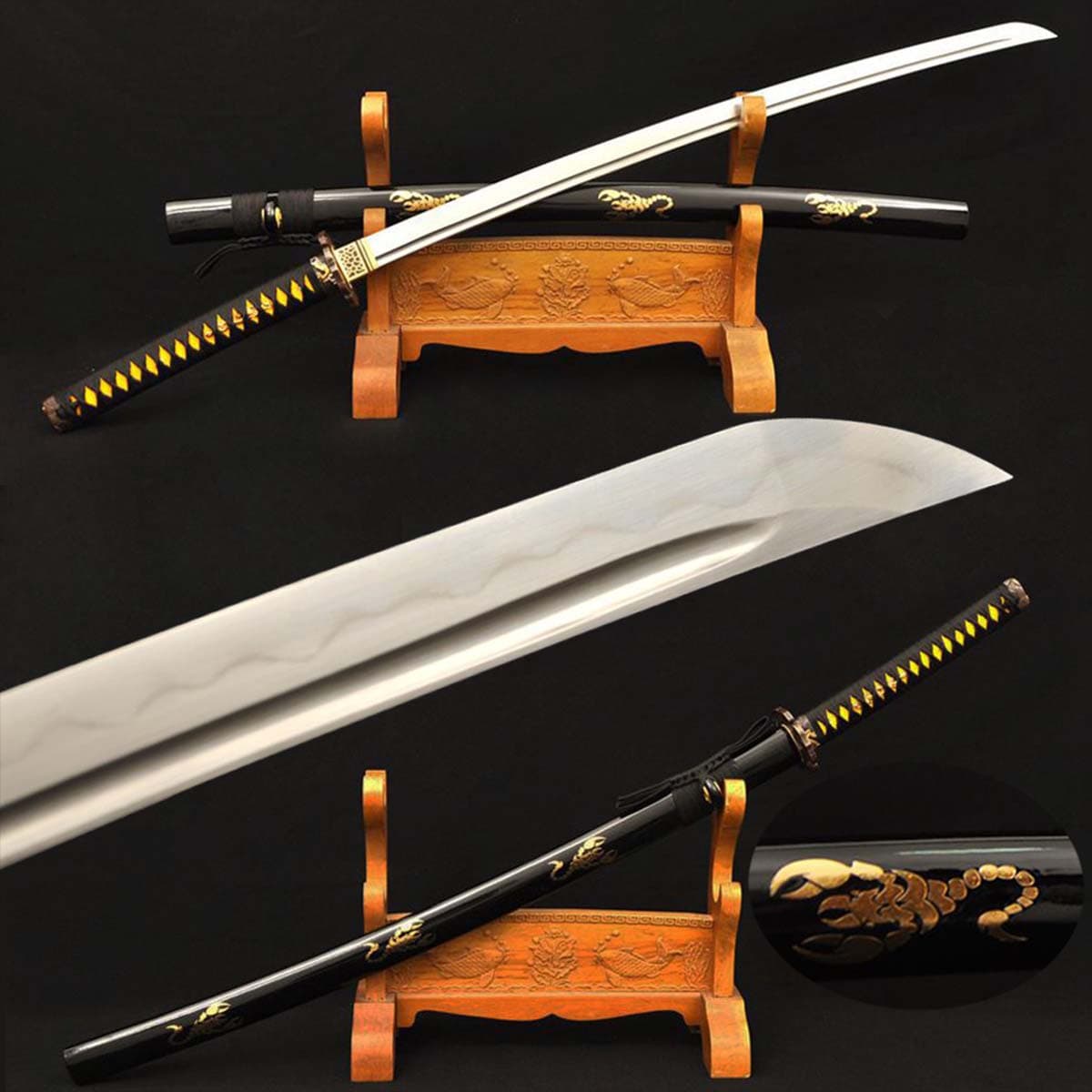 The quenching process adopts differential heat treatment technology. The blade part is coated with a 0.3mm thick clay layer, and the back of the blade remains exposed. After heating to 800°C, quickly immerse in special quenching oil at 35°C, with the cooling rate controlled at 130°C per second. The resulting martensite conversion rate can reach 97%, with a hardness of HRC62-64, while the back of the tool retains the toughness of HRC40-42. This hardness gradient enhances the impact toughness of the cutting tool by 35%, meeting the performance standards for modern samurai swords set by the Japan Sword Association.
The grinding and polishing process consists of eight steps, using natural grinding stones with particle sizes ranging from 120 mesh to 12,000 mesh. The surface roughness of the edge polishing accuracy reaches Ra0.05μm, and the curve error of the tool body is controlled within ±0.15mm. The final completed katana scorpion has an average weight of 980±20g, the center of gravity is located 38±2mm in front of the guard, and the moment of inertia during swinging is 0.085kg·m². These parameters have been verified through 300 dynamic tests to ensure they meet the mechanical requirements of actual combat cutting.
During the quality inspection stage, non-destructive testing techniques are adopted. X-ray flaw detection can detect internal defects with a depth of ≥0.02mm, and ultrasonic testing ensures that the deviation of the grain flow direction from the cutting edge Angle is less than 3°. Each knife must pass the cutting test. When cutting a wet straw mat with a density of 0.45g/cm³ at a 30° Angle, it can continuously cut a bamboo bundle with a diameter of 4cm 12 times without the edge curling. This strict quality control has enabled Katana Scorpion to achieve a customer satisfaction rating of 98.7% in the industry.
The quenching process adopts differential heat treatment technology. The blade part is coated with a 0.3mm thick clay layer, and the back of the blade remains exposed. After heating to 800°C, quickly immerse in special quenching oil at 35°C, with the cooling rate controlled at 130°C per second. The resulting martensite conversion rate can reach 97%, with a hardness of HRC62-64, while the back of the tool retains the toughness of HRC40-42. This hardness gradient enhances the impact toughness of the cutting tool by 35%, meeting the performance standards for modern samurai swords set by the Japan Sword Association.
The grinding and polishing process consists of eight steps, using natural grinding stones with particle sizes ranging from 120 mesh to 12,000 mesh. The surface roughness of the edge polishing accuracy reaches Ra0.05μm, and the curve error of the tool body is controlled within ±0.15mm. The final completed katana scorpion has an average weight of 980±20g, the center of gravity is located 38±2mm in front of the guard, and the moment of inertia during swinging is 0.085kg·m². These parameters have been verified through 300 dynamic tests to ensure they meet the mechanical requirements of actual combat cutting.
During the quality inspection stage, non-destructive testing techniques are adopted. X-ray flaw detection can detect internal defects with a depth of ≥0.02mm, and ultrasonic testing ensures that the deviation of the grain flow direction from the cutting edge Angle is less than 3°. Each knife must pass the cutting test. When cutting a wet straw mat with a density of 0.45g/cm³ at a 30° Angle, it can continuously cut a bamboo bundle with a diameter of 4cm 12 times without the edge curling. This strict quality control has enabled Katana Scorpion to achieve a customer satisfaction rating of 98.7% in the industry.
The quenching process adopts differential heat treatment technology. The blade part is coated with a 0.3mm thick clay layer, and the back of the blade remains exposed. After heating to 800°C, quickly immerse in special quenching oil at 35°C, with the cooling rate controlled at 130°C per second. The resulting martensite conversion rate can reach 97%, with a hardness of HRC62-64, while the back of the tool retains the toughness of HRC40-42. This hardness gradient enhances the impact toughness of the cutting tool by 35%, meeting the performance standards for modern samurai swords set by the Japan Sword Association.
The grinding and polishing process consists of eight steps, using natural grinding stones with particle sizes ranging from 120 mesh to 12,000 mesh. The surface roughness of the edge polishing accuracy reaches Ra0.05μm, and the curve error of the tool body is controlled within ±0.15mm. The final completed katana scorpion has an average weight of 980±20g, the center of gravity is located 38±2mm in front of the guard, and the moment of inertia during swinging is 0.085kg·m². These parameters have been verified through 300 dynamic tests to ensure they meet the mechanical requirements of actual combat cutting.
During the quality inspection stage, non-destructive testing techniques are adopted. X-ray flaw detection can detect internal defects with a depth of ≥0.02mm, and ultrasonic testing ensures that the deviation of the grain flow direction from the cutting edge Angle is less than 3°. Each knife must pass the cutting test. When cutting a wet straw mat with a density of 0.45g/cm³ at a 30° Angle, it can continuously cut a bamboo bundle with a diameter of 4cm 12 times without the edge curling. This strict quality control has enabled Katana Scorpion to achieve a customer satisfaction rating of 98.7% in the industry.
Continue Reading
Read every essay since 2017 — including the full archive of 612 issues — by becoming a member.