
Dynea, Black, Brown or Anti-Slip: Choosing a Surface
Five film options are published for Dongstar's formwork panels: Dynea dark brown film, black film, brown film, Anti Slip film and plastic film as the five options. All of them can be pressed onto poplar, eucalyptus, combi or birch cores, in thicknesses of 9, 12, 15, 18, 21 or 24 mm with a ±0.5 mm tolerance. The film decides how the concrete looks and how the panel survives the yard; the core decides what it can carry.
Key takeaways
- Five films are listed: Dynea dark brown film, black film, brown film, Anti Slip film and plastic film.
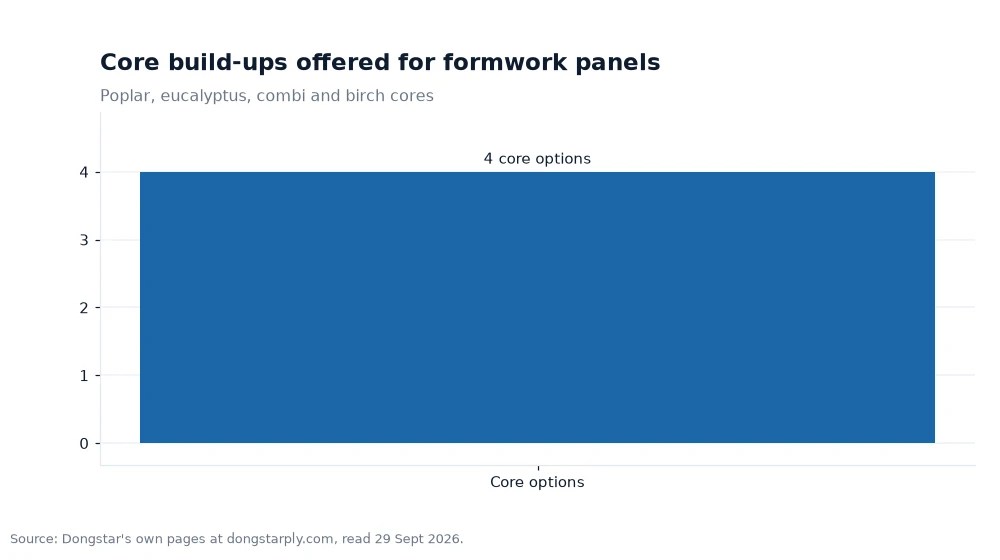
- Four cores are offered underneath them: poplar, eucalyptus, combi and birch.
- Black film is described as uniform and resistant to water, chemicals and wear; brown film as durable and cost-effective.
- Waterproof edge sealing is a separate option that controls how many pours a panel survives.
Five films, five different site habits
A film choice is usually presented as a finish decision, but it is really a decision about handling. The face that touches the concrete determines the surface the client sees, and it also determines how the panel behaves when it is stacked, moved, clamped and cleaned between pours. Two panels with the same core and the same glue can perform very differently on site because of nothing more than the face they were pressed with.
That is why a Film Faced Plywood range lists five rather than one. A contractor pouring fair-faced walls cares about uniformity and release. A yard that shifts panels with a forklift cares about grip. A buyer running a large foundation contract cares about cost per square metre and how many times a panel can be used before the face gives up. Each of those buyers is looking at a different line in the same specification.
Dynea dark brown film: the reference face
Dynea dark brown film is the face most closely associated with formwork work, and it comes out of a partnership with Dynea of Finland — a relationship the group lists among its own credentials. The dark brown tone gives the surface a consistent colour that makes patches and scuffs easy to spot during inspection, and it is the name that appears first in the published face list, ahead of black, brown, anti-slip and plastic.
Specifying a named film rather than "filmed panel" matters when a project is repriced. Two suppliers can both offer a dark faced panel and still be selling different products, and the difference only appears after several pours, when one face resists the jointing and cleaning cycle and the other has absorbed water along its edges. Naming the film in the enquiry moves that comparison into the quotation, where it is cheap.
Black film and brown film: contrast against cost
Black film is described as high contrast and uniformly surfaced, with resistance to water, chemicals and wear. Uniformity is the property that matters for exposed concrete, because any variation in the face prints itself onto the wall, and a chemical-resistant surface cleans up more easily after a pour. It is the face to look at when a client has specified an architectural finish and the panels will be judged by eye.
Brown film takes the other position in the range: durable and cost-effective, aimed squarely at construction work. On foundation walls, retaining structures and pours where the concrete is backfilled or rendered afterwards, the face's colour is irrelevant and what matters is that it stays intact through the job. Paying for contrast on a wall nobody will ever see is the most common overspecification in formwork purchasing. The range also describes a red film, bright in colour with similar water, strength and protection behaviour, for situations where visibility on site is the point.
Anti Slip film: the workshop and yard answer
Anti Slip film is the option the range describes as being used in workshops to stop vehicles sliding. That is a handling problem rather than a concrete problem, and it turns up in exactly the places you would expect: stacks in the yard, loading bays, ramps, and any route where a forklift crosses panels lying on the ground. A slippery stack of filmed sheets is a genuine hazard, and a textured face removes most of it.
The trade-off is that the same texture prints onto concrete. A panel faced for grip will not give the same flat, uniform surface as a smooth film, so it belongs on pours with a rough or covered finish — or on panels whose main job is internal handling rather than an exposed face. Projects that need both often keep two small panel groups: anti-slip faces for the yard and general work, smooth faces reserved for the pours that will be seen.
Plastic film and the core that carries it
Plastic film completes the published list. It is the option for buyers who need a plastic face rather than a paper-based film, whether for cleaning, contamination control or the way the panel is stripped and re-used. As with the other four, it is pressed onto a core chosen separately, and the core list runs to four species: poplar, eucalyptus, combi and birch.
Poplar is light, straight-grained, stable and easy to machine, which suits interior end uses such as cabinets and furniture. Eucalyptus adds strength, durability and moisture resistance for load-bearing work. Combi balances cost against performance, and birch sits at the strong end. Because the four cores are offered under all five films, a buyer can specify a light poplar core with a plastic face for one panel group and a eucalyptus core with black film for another, on the same order.
| Face | As described by the maker | Where it tends to fit |
|---|---|---|
| Dynea dark brown film | Reference formwork face, pressed under the Dynea partnership | Repeated pours with a consistent surface |
| Black film | High contrast, uniform, resistant to water, chemicals and wear | Exposed concrete judged by eye; easy clean-down |
| Brown film | Durable and cost-effective for construction work | Foundations and pours that get covered or rendered |
| Anti Slip film | Used in workshops to stop vehicles sliding | Yards, ramps, loading areas, internal handling |
| Plastic film | Listed plastic face option | Cleaning, contamination control and strip-and-reuse work |
Worked example: what the face costs across a 300-panel order
Three formats are published, and the surface area they carry differs enough to matter on a large order. A 1220 × 2440 mm panel covers 1.22 m × 2.44 m = 2.9768 m², so 300 panels carry 300 × 2.98 = 894 m² of formed face (example). The largest published format, 1250 × 2500 mm, measures 1.25 m × 2.5 m = 3.125 m², so 300 panels carry 300 × 3.125 = 937.5 m² (example) — about 4.9% more face for the same number of panels.
The third format, 900 × 2100 mm at 0.9 m × 2.1 m = 1.89 m², gives 300 × 1.89 = 567 m² (example), which is more than a third less face per panel but far easier to lift. If the film is the expensive part of the panel, the format that carries the most square metres per sheet is the cheaper way to buy it; if handling drives the cost, the small panel wins. Neither answer is universal, which is why the format belongs in the first email rather than the last.
Frequently asked questions
Can one order mix several films?
Yes, and it is a common way to buy. Panels for the yard can take Anti Slip film while the panels reserved for exposed pours take a smooth face, and both can sit on the same core. The faces are pressed separately, so the pack should be labelled by group.
Which film gives the best concrete surface?
The one that is uniform and intact. Black film is described as uniformly surfaced with resistance to water, chemicals and wear, while the dark brown reference face is the established formwork choice. Whichever is used, a scratched or damaged face prints its damage into the concrete.
Does the film choice affect the core choice?
No. The four cores — poplar, eucalyptus, combi and birch — are offered under all five films, so grip, contrast and load capacity are specified independently. That independence is what lets a light panel and a load-bearing panel travel in the same shipment.
Name the face, then the core, then the edge
Three lines in an enquiry settle the whole panel: which film, which core, which edge treatment. Buyers who write them down get comparable quotations instead of a choice between two unnamed boards, and the edge specification matters as much as the face once the panels start a reuse cycle. Contractors building a full system usually pick their support from the formwork beam range at the same time, and where a pour needs a panel whose veneer build is the visible face, the laminated structural sheets are the ones to price alongside.
Source: that company's own pages, read on 29 September 2026, as the source for this write-up[1].