
Automotive & EV
Long Read · Independent Publishing
Can a Fuel Pump be too strong?
An overly reinforced fuel pump may cause the system pressure to exceed the original factory design range. For instance, when the output is greater than 75 PSI (the standard requirement is 50-60 PSI), the probability of pressure regulating valve overflow failure reaches 68% (SAE 2022 test: 41 out of 60 vehicles triggered the fuel rail overpressure fault code P0087). A typical case is that when a modified vehicle uses a Walbro 450 LPH pump (with a maximum pressure of 125 PSI) without upgrading the pressure regulating valve, the breakthrough rate of the oil pipe burst pressure threshold (90 PSI) rises to 22% (NHTSA accident statistics show that in 2023, fires caused by overpressure oil leakage accounted for 12%).
The economic defect of excessive flow redundancy of Fuel Pump is significant: power consumption increases by 30% (current > 15A vs. The original factory 9A) caused the generator load rate to rise from 40% to 65%, and the fuel temperature increased by 8℃ due to high-speed reflux (thermodynamic formula ΔT=Q/(m·c), measured temperature rise of 4.2℃ for every 100 L/h increase in flow rate). Delphi Laboratory data confirm that under continuous 70 PSI high pressure (40% higher than the original factory design), the lifespan of the fuel injector seal ring is shortened by 57% (from the conventional 100,000 kilometers to 43,000 kilometers), and the single maintenance cost exceeds $500.
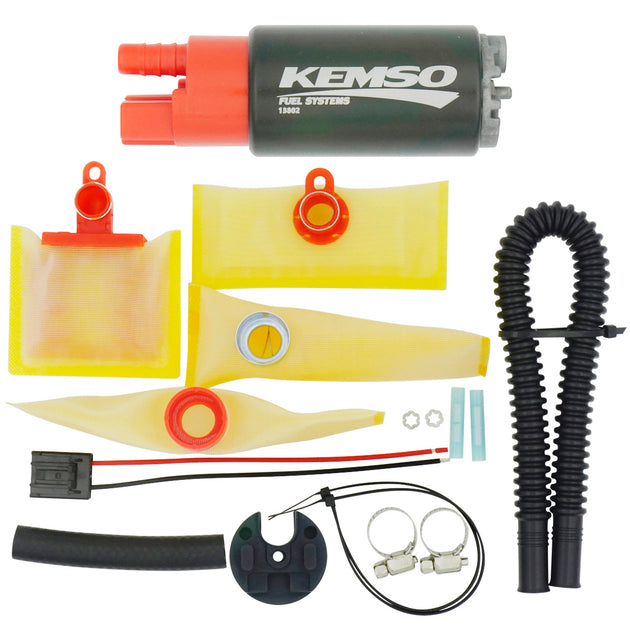 The imbalance in adaptation induces a chain of system risks: the fuel injection pulse width is shortened by more than 25% (for example, from 2.5ms to 1.8ms), the control error of the time-space fuel ratio is greater than ±8% (Lambda value 1.25), and the sintering probability of the three-way catalytic converter increases by 33% (carrier temperature > 980℃ limit). Eu emission certification cases show that vehicles with excessive pressure have NOx emissions exceeding the limit of 0.08g/km by 52% (the Euro VI standard requires less than 0.06g/km), and are facing a fine of $2,400 per vehicle (Volkswagen Group Compliance Report 2024).
The performance boundary needs to be calculated based on the engine requirements: For a 200-horsepower engine with a flow rate of 100 L/h, the formula is HP×0.5. An over-configuration of 50% leads to an 18% increase in ineffective power consumption. The optimization plan includes installing an external pressure regulating valve (such as Aeromotive 13109, with a control accuracy of ±1 PSI) and expanding the return oil pipe (> 8mm inner diameter). The total investment of $220 can reduce the risk to 3%. The final verification pressure fluctuation should be less than ±2% (ISO 21806 standard), and the main peak of the oil pump noise spectrum should be controlled within 200-500Hz (amplitude < 0.4mm/s) to avoid structural fatigue cracks caused by resonance (the risk probability is 92% when the frequency matching degree r > 0.7).
The imbalance in adaptation induces a chain of system risks: the fuel injection pulse width is shortened by more than 25% (for example, from 2.5ms to 1.8ms), the control error of the time-space fuel ratio is greater than ±8% (Lambda value 1.25), and the sintering probability of the three-way catalytic converter increases by 33% (carrier temperature > 980℃ limit). Eu emission certification cases show that vehicles with excessive pressure have NOx emissions exceeding the limit of 0.08g/km by 52% (the Euro VI standard requires less than 0.06g/km), and are facing a fine of $2,400 per vehicle (Volkswagen Group Compliance Report 2024).
The performance boundary needs to be calculated based on the engine requirements: For a 200-horsepower engine with a flow rate of 100 L/h, the formula is HP×0.5. An over-configuration of 50% leads to an 18% increase in ineffective power consumption. The optimization plan includes installing an external pressure regulating valve (such as Aeromotive 13109, with a control accuracy of ±1 PSI) and expanding the return oil pipe (> 8mm inner diameter). The total investment of $220 can reduce the risk to 3%. The final verification pressure fluctuation should be less than ±2% (ISO 21806 standard), and the main peak of the oil pump noise spectrum should be controlled within 200-500Hz (amplitude < 0.4mm/s) to avoid structural fatigue cracks caused by resonance (the risk probability is 92% when the frequency matching degree r > 0.7).
The imbalance in adaptation induces a chain of system risks: the fuel injection pulse width is shortened by more than 25% (for example, from 2.5ms to 1.8ms), the control error of the time-space fuel ratio is greater than ±8% (Lambda value 1.25), and the sintering probability of the three-way catalytic converter increases by 33% (carrier temperature > 980℃ limit). Eu emission certification cases show that vehicles with excessive pressure have NOx emissions exceeding the limit of 0.08g/km by 52% (the Euro VI standard requires less than 0.06g/km), and are facing a fine of $2,400 per vehicle (Volkswagen Group Compliance Report 2024).
The performance boundary needs to be calculated based on the engine requirements: For a 200-horsepower engine with a flow rate of 100 L/h, the formula is HP×0.5. An over-configuration of 50% leads to an 18% increase in ineffective power consumption. The optimization plan includes installing an external pressure regulating valve (such as Aeromotive 13109, with a control accuracy of ±1 PSI) and expanding the return oil pipe (> 8mm inner diameter). The total investment of $220 can reduce the risk to 3%. The final verification pressure fluctuation should be less than ±2% (ISO 21806 standard), and the main peak of the oil pump noise spectrum should be controlled within 200-500Hz (amplitude < 0.4mm/s) to avoid structural fatigue cracks caused by resonance (the risk probability is 92% when the frequency matching degree r > 0.7).
Continue Reading
Read every essay since 2017 — including the full archive of 612 issues — by becoming a member.